
The Heart in Jewellery: A Symbol We Never Outgrew
Some symbols belong to a particular civilisation or moment in history. The heart is different. It has travelled through centuries of jewellery, changing its appearance while retaining essentially the same message: this matters to me.
Long before the familiar heart became the universal shorthand for romantic love, the heart carried profound symbolic meaning. In the ancient world it could represent the centre of life, character and the soul. In ancient Egypt, the ib, or heart, was believed to contain something essential about the individual and was weighed after death against the feather of Ma’at.
The recognisable heart shape developed much later. By the Middle Ages it was increasingly associated with courtly love and devotion, appearing in manuscripts and eventually in personal objects and jewels. By the Renaissance, giving a heart-shaped jewel could become an intimate declaration—something worn close to the body that communicated affection without words.
(Caption to be added)
Over the following centuries, jewellers became wonderfully inventive with the form.
Hearts were crowned to signify loyalty, pierced by arrows for romantic passion, combined with hands and crowns in Irish Claddagh jewellery, or fashioned as lockets containing a portrait or a lock of hair. Two hearts could signify two lives joined together. During periods of mourning, the same shape could speak not of new love but of love that continued after death.
By the Georgian and Victorian periods, sentimental jewellery had developed an extraordinarily rich visual language. Diamonds, pearls, turquoise, garnets and coloured gemstones could all contribute additional layers of meaning. A heart was no longer simply decoration; it might commemorate a marriage, friendship, bereavement or private attachment known only to its wearer.
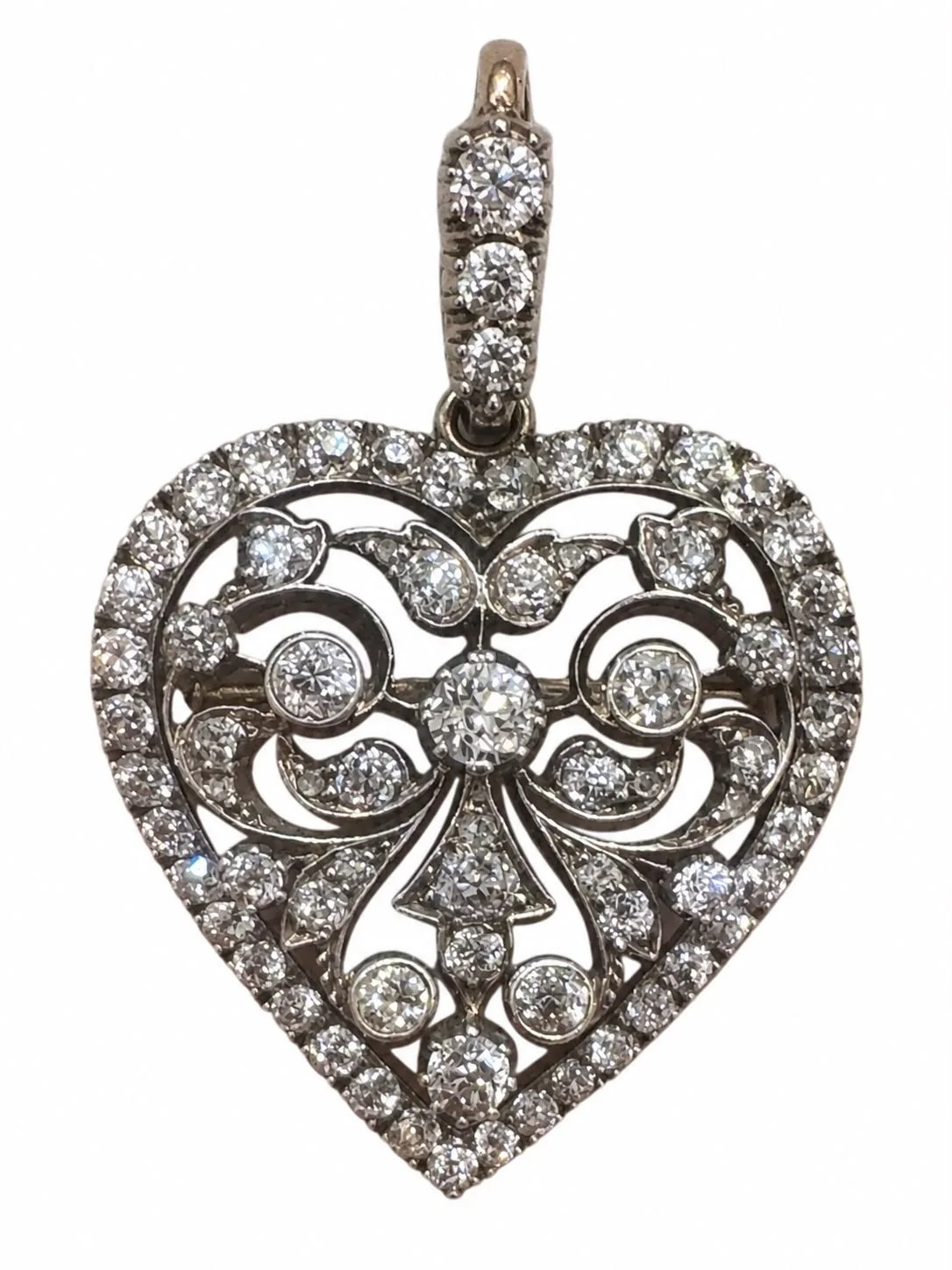
The diamond heart illustrated here belongs beautifully to that tradition.
Its openwork design is constructed almost like a miniature piece of architecture, with scrolling foliage arranged symmetrically around old-cut diamonds. The silver-toned diamond settings contrast with the warmer metal visible to the reverse, a combination characteristic of jewellery made before platinum became widely used. The surviving pin fitting also allows the jewel to be worn as a brooch, while the upper fitting permits it to be suspended as a pendant—a wonderfully practical feature in antique jewellery.
And then there are the diamonds themselves.
They are not clinically identical. Their old cuts have individual proportions and personalities, catching candlelight and modern light quite differently from today’s precisely calibrated brilliant cuts. That slight irregularity is part of their beauty. This was jewellery made by hands rather than algorithms.
Perhaps that is why antique heart jewels remain so compelling.
A diamond may survive for centuries. Gold can be repaired, settings restored and a jewel passed from one generation to another. But the person who first gave it, the person who first wore it, and the particular love it once represented eventually disappear from living memory.
The heart remains.
At Astoria, that is what draws us to sentimental jewellery. We may never discover every name or every love story behind an antique jewel. Yet the object itself tells us something wonderfully human: across centuries, people have always wanted to turn feelings that cannot be held into objects that can.
And few forms have done that more beautifully than the heart.